
UK Tennis Betting · Analysis
Betting on Tennis: The Complete UK Guide to Markets, Odds and Integrity
 Available in US
Tennis betting decoded by data, not hype.

The first serious money I ever lost on betting on tennis went on a player who was, by every number I trusted at the time, a lock. He pulled up injured at one set all, my stake disappeared into a settlement rule I had never bothered to read, and I learned more from that single afternoon than from any winning week in the six years since. That is the spirit of everything that follows: betting on tennis decoded by data, not by hype, gut feeling or whatever a tipster happens to be selling this week.
Tennis is a strange and brilliant sport to wager on. It runs almost twelve months a year, every match resolves to a single winner with no draw to muddy the price, and the scoring builds in natural swings of momentum that the markets reprice point by point. That combination is exactly why the in-play screens light up the way they do, and it is also why so much published advice is shallow. Most of the guides that rank above this one are stuffed with bonus codes and "most profitable strategy" claims that no one ever backs up with a figure.
My job here is different. I work as a tennis betting analyst, and I spend my days on market structure, surface-adjusted models, in-play value and, increasingly, the integrity questions that sit underneath the whole sport. This guide walks you through the markets, the odds, live play, choosing a licensed UK operator, whether tennis is actually fixed, the 2026 regulatory picture and how to bet without it costing you more than money. It is a map of the territory, with each region explored in full in its own article.
The single most useful idea in this guide is also the simplest: a tennis price is a probability, and your edge comes from disagreeing with that probability for a reason you can write down. Everything else is detail.
What this guide covers in 60 seconds
- Tennis is the fastest-growing slice of online sports betting, on a projected 13.83% annual growth path to 2031, and over half of all bets on the sport are now placed live, point by point.
- Start with the four core markets — match winner, set betting, handicaps and total games — and read fractional UK odds as implied probability before you back anything.
- Integrity matters: tennis produced 58 suspicious betting alerts in 2024, with the real risk concentrated in lower tiers rather than the Grand Slams.
- Bet only with a UK Gambling Commission licensed operator, use the built-in deposit limits, and treat the helpline on 0808 8020 133 as a tool, not an admission.
Why tennis has quietly become the smart bettor's sport
Walk into any betting shop on a Saturday and the screens are wall-to-wall football and horse racing. That picture is badly out of date. Behind the scenes, tennis has become the single fastest-growing product in online betting, and the gap is not close.

The growth numbers are the part that surprised even me. Tennis is projected to expand at a compound annual rate of 13.83% through to 2031, the highest of any sport, while the tennis betting segment itself was valued at roughly 16.53 billion dollars in 2025, somewhere near a tenth of the entire market. Compare that with football, which still holds the largest single share at 35.27%, and you see the shape of the story: football remains the giant, but tennis is the one closing the distance fastest. Money follows attention, and attention has been quietly migrating towards the baseline.
There are structural reasons for this, not just fashion. A football match gives you one result every ninety minutes. A best-of-three tennis match can hand a bookmaker dozens of natural betting moments — every game, every break point, every shift of serve — and each of those is a fresh price to be offered and taken. The sport is, in betting terms, unusually dense. You are never waiting long for the next decision.
Tennis almost never sleeps. The professional tours run from the first week of January in Australia to late November, which means there is meaningful, liquid betting on a genuine professional match on very nearly every day of the year. No other major sport offers that kind of uninterrupted supply.
For a UK bettor this matters in a practical way. A deep, fast-growing market means tighter prices on the big matches, more markets offered on the small ones, and far more in-play liquidity than the sport had even five years ago. The flip side is that more attention also means more sophistication on the other side of the bet. The bookmaker has better models than it used to. None of that should put you off. It simply means the casual approach that worked a decade ago — back the famous name, hope for the best — is now the slowest possible way to lose your bankroll. The rest of this guide is about replacing it with something better.
How I would start again if I were brand new
If I could hand my younger self one instruction before his first tennis bet, it would be this: slow down. The mistake almost every beginner makes is treating the first bet as the goal, when the first bet should be the least interesting thing you do all week. Roughly 22.5 million British adults bet in a typical month, which tells you this is mainstream leisure, not a secret society — and it also tells you the operators are extremely good at making it easy to start before you are ready.

Getting set up is genuinely simple. You open an account with a UK-licensed operator, complete the identity and age checks that the law requires, deposit a sum you have already decided you can afford to lose, and you are technically ready to bet. The technical part takes ten minutes. The part that actually determines whether you enjoy this or regret it takes a little longer, and it happens before you ever touch the deposit button.
Here is the sequence I wish someone had drilled into me. First, decide your total bankroll — the ring-fenced amount that is for betting and nothing else. Second, pick a unit size, typically one to two percent of that bankroll, and treat it as your standard stake. Third, choose one or two markets you actually understand rather than dabbling in everything. Fourth, write down why you are placing each bet, even if it is one sentence. That note is the difference between a hobby and a habit you can review.
Run this before you confirm any tennis bet
- Is the operator licensed by the UK Gambling Commission, and have I checked the licence rather than assumed it?
- Is this stake within my pre-set unit size, not a number my mood invented thirty seconds ago?
- Do I understand exactly how this market settles, including what happens if a player retires?
- Have I read the price as a probability and decided I disagree with it, or am I just backing the favourite out of habit?
- Would I be comfortable explaining this bet, out loud, to someone whose judgement I respect?
None of that is glamorous, and none of it appears in the adverts. But the bettors who last are almost always the ones who got boring on purpose at the very start. The thrill is supposed to come from being right about a match, not from the dopamine of clicking confirm. Once the plumbing is in place, you can spend your energy where it belongs — on understanding what you are actually betting on.
The markets, mapped from the one bet everyone makes
Ask a hundred new bettors what they backed on a tennis match and ninety-five will say the same thing: the winner. There is nothing wrong with the match winner market, but treating it as the only option is like walking into a restaurant and ordering bread because it is the first thing you recognise. The menu is far wider, and the interesting value usually lives further down it.
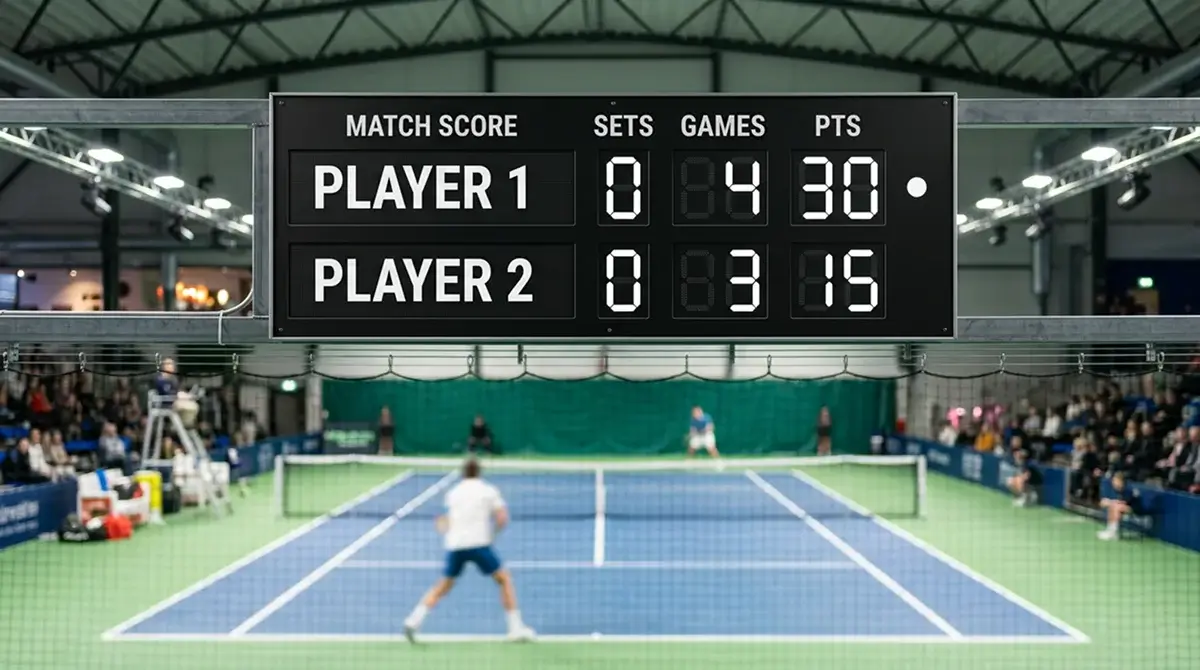
Let me give you the lay of the land. The markets you will meet most often cluster into a handful of families, and understanding the families matters more than memorising every individual bet.
Match winner
The simplest bet: who wins the match. No draw, so the two prices cover every outcome. Your starting point, rarely your best value.
Set betting
Backing the exact set outcome, such as a two-set or three-set win. Longer odds than the match winner because you are predicting how, not just who.
Handicaps
The bookmaker hands one player a head start or deficit, measured in sets or in games, to balance a lopsided match into a coin-flip price.
Total games
An over or under line on the number of games in the match, driven by serve quality rather than by who is the better player.
Props and specials
Aces, double faults, whether a tiebreak occurs, correct score by sets — granular markets that reward specific knowledge of style.
Outright and futures
Backing a player to win an entire tournament, placed days or weeks ahead, with the draw and seeding shaping the price.
The reason this taxonomy is worth learning is that the markets behave very differently, and the same match can be a poor bet in one and a strong one in another. A heavy favourite is dull at short odds in the match winner market but can be genuinely interesting on a set handicap. Two huge servers on a fast court are a guessing game on the winner but often a readable bet on total games.
Handicap — a notional advantage or disadvantage applied to a player to even out the contest, expressed in sets, such as plus or minus 1.5 sets, or in games, such as minus 3.5 games. Your bet is on the result after that adjustment, not the raw scoreline.
One number anchors why these markets keep proliferating: in tennis, point-by-point live betting now accounts for over 55% of all bets placed on the sport. Operators build out granular markets precisely because punters keep finding new things to bet on as a match unfolds. The breadth is not an accident; it is the product responding to demand.
This guide stays at the level of the map. Each family rewards a deeper look, and I take the markets apart one by one — when each offers value, how they settle, where the traps sit — in the dedicated breakdown of every tennis betting market explained. Treat the overview here as the choice of which door to walk through, and that article as what is behind each one.
The day fractions finally clicked for me
For my first few months I read British odds the way most newcomers do — as a vague signal of "more likely" or "less likely" — and I had no real idea what I would win until the bet settled. That is no way to operate. Odds are not decoration; they are a sentence about probability written in a slightly awkward dialect, and once you can translate it, the whole sport reads differently.

UK bookmakers traditionally quote in fractions: 5/2, 4/6, evens. The fraction tells you what you win relative to what you stake. At 5/2 you win five for every two staked, and you also get your stake back. At 4/6 you win four for every six staked, which is the bookmaker's way of describing a favourite. Evens, written 1/1, means you win exactly what you put on. The trick that unlocks everything is converting that fraction into an implied probability, because that probability is what you are really being asked to agree or disagree with.
Reading a fraction as a probability
Suppose a player is quoted at 5/2 to win a match.
Your return if right: a 10-pound stake returns the 25-pound winnings plus your 10-pound stake, so 35 pounds in total.
The implied probability: divide the second number by the sum of both. Here that is 2 divided by 2 plus 5, which is 2 over 7, or roughly 28.6%.
The decision: you only have a bet worth making if you genuinely believe this player wins more often than 28.6% of the time. If you think it is closer to 35%, you have found value. If you think it is 25%, the price is against you no matter how much you like the player.
That last point is the entire game in miniature. The odds are the bookmaker's stated probability, padded slightly in its favour, and your only durable edge is finding spots where your own estimate is meaningfully different and better. You do not have to do this arithmetic in your head forever — most people drift towards decimal odds for speed, and the conversion is straightforward — but you do have to internalise the principle. A favourite is not a good bet because they are likely to win. A favourite is a good bet only when the price underrates how likely they are to win. Hold that thought and most bad bets simply stop being tempting.
The tennis price decoder
Tennis has no draw, so the two match-winner prices cover every outcome between them. That is a structural gift: unlike football, you can strip a tennis book down to its exact margin with nothing but the two quotes. Enter both prices, add your own read on the favourite, and this works out what the bookmaker really thinks, what it is charging you to find out, and whether your number is far enough from theirs to be worth a stake.
- Player A — fair price
- —
- Player B — fair price
- —
Your own read on how often Player A wins this match. Player B is whatever is left.
—
Quarter-Kelly stake on the side with the edge.
How this reads a price
Implied probability. Every price is a probability wearing a disguise. A fraction of 5/2 becomes 2 divided by 7, or 28.6%. A decimal of 3.50 becomes 1 divided by 3.50, the same 28.6%. That figure is the break-even point: below it the bet loses money over a long run, above it the bet makes money, and nothing about how much you like the player changes that.
Margin, and why tennis is the easy case. Add the two implied probabilities together and the total comes to more than 100%. The excess is the overround, the bookmaker's built-in cut, and it is the reason a bettor who is right exactly half the time still goes broke. In football you need three prices to see it and the draw muddies the picture. In tennis two prices cover the whole outcome space, so the margin falls straight out of the arithmetic. Roughly speaking, anything under 3% on a main-tour match is a sharp book, 4% to 6% is normal, and figures above 8% usually mean a lower-tier match with thin liquidity.
Fair price. Strip the margin out proportionally and you get the price the bookmaker would offer if it took no cut at all — the closest thing available to its true opinion. Comparing your estimate against the fair price, rather than the offered price, tells you whether you actually disagree with the market or are just paying the toll. This tool uses the proportional method, which is the standard approach and slightly understates long shots because of favourite-longshot bias; more elaborate methods exist and matter most at extreme prices.
Expected value and stake size. Expected value per pound is your probability multiplied by the decimal price, minus one. Positive means the bet makes money if — and only if — your probability is right. The staking figure is the Kelly criterion, which maximises long-run growth, divided by four. The quartering is not caution for its own sake: Kelly assumes your estimate is exact, real estimates never are, and full Kelly on a slightly wrong number is a fast route to a wrecked bankroll. If quarter-Kelly is telling you to stake more than about 5% of your pot, the honest reading is that your estimate is probably too confident rather than that you have found a monster bet.
Why I do most of my thinking after the first ball is struck
The most profitable habit I have built in six years is also the one that felt most counterintuitive at first: I place a large share of my bets after a match has started, not before. Pre-match, I am guessing alongside everyone else. In-play, I am watching real information arrive — a tight service game, a visible drop in movement, a momentum swing — and pricing it before the screen catches up.

The market agrees with me, at scale. Live betting now makes up 62.35% of the entire online sports betting market, growing at a 13.62% annual clip, and on the mature European markets where most UK bettors operate, in-play turnover on the major football and tennis matches has already overtaken pre-match betting entirely. Tennis is the purest expression of this. The point-by-point structure means the price is genuinely repriced every few seconds, and that constant motion is both the opportunity and the danger.
Here is the part newcomers underestimate. Live tennis is not "the same bet, but during the match." It is a different discipline with its own rhythm. A break of serve can swing a match price violently in a heartbeat, and the bookmaker's algorithm reacts faster than you can. The skill is not reacting fastest — you will lose that race — but understanding which swings are noise and which are signal, and having decided your line before the moment arrives.
Pre-match versus in-play, by character
| Dimension | Pre-match | In-play |
|---|---|---|
| Information | Form, surface, head-to-head, fixed before the off | Live evidence: momentum, fatigue, body language, scoreline |
| Price movement | Drifts slowly as money arrives | Repriced point by point, often violently after a break |
| Main risk | Acting on stale or incomplete information | Overtrading and chasing every swing |
| Best suited to | Patient, model-driven selection | Disciplined readers of a single match in real time |
The single most common way to lose money in-play is to treat it as a slot machine — a bet on every game because the buttons are right there. Liquidity and speed make that frictionless, and frictionless is rarely your friend. I cover the mechanics properly, including how the prices are calculated and how to read momentum without being whipsawed by it, in the full treatment of live tennis betting and in-play markets. For the pillar, hold onto this: live is where tennis betting becomes a skill rather than a punt, and skill demands restraint.
Same players, different sport, depending on what is under their feet
I once watched a player who had looked unbeatable on hard courts get dismantled three weeks later on clay by an opponent ranked sixty places below him. Nothing about the players had changed. The ground had. If there is one piece of tennis knowledge that separates bettors who understand the sport from those who merely follow it, it is that the surface is not a footnote — it is a variable that reshapes who is good and how matches are scored.
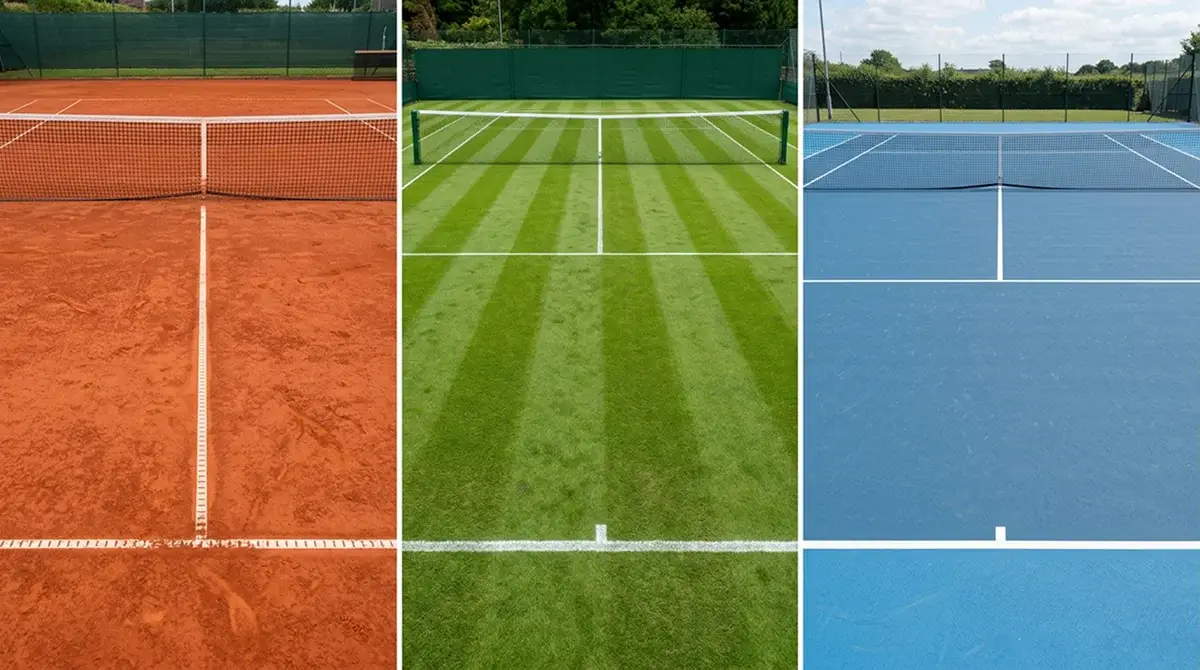
The three surfaces play like three different games. Clay is slow, the ball sits up, rallies lengthen, and breaks of serve come more often, which tends to push total games higher and reward grinders and movers. Grass is the opposite — fast, low, short points, the serve dominates, and a big server can hold their way through a tournament almost on autopilot. Hard courts sit in the middle, the neutral baseline against which the others are measured, though even there indoor and outdoor conditions diverge.
For a bettor, the surface does not just change who wins. It changes which markets are worth betting at all. Total games behave differently on clay than on grass. Ace and serve-prop markets come alive on fast surfaces and go quiet on slow ones. A player's ranking can badly misprice them in the weeks the tour changes surface, because the market is slow to adjust and the casual money keeps backing reputations.
The Grand Slams sit on top of all this as the high-liquidity centrepieces of the calendar. Each of the four runs across roughly 14 days, and that fortnight produces a continuous, uninterrupted stream of in-play markets that keeps liquidity unusually deep. The Australian Open opens the year on hard courts, Roland-Garros is the great clay test, Wimbledon the grass showpiece, and the US Open closes the Slam season back on hard. Each rewards a different reading of the same players.
The practical upshot is that you should never carry a single mental model of a player from one season to the next without adjusting for the ground. A clay specialist backed blindly at Wimbledon is a donation. A grass-court server underrated in the second week of the lawn season can be a gift. The surface is the lens; everything else is what you see through it. Surface-adjusted thinking is the backbone of a real strategy, which is exactly where this guide goes next.
Strategy is a process you can repeat, not a tip you can buy
Every week someone messages me asking for "the strategy," as if there is a secret formula locked in a vault. There is not. The closest thing I have to a secret is profoundly unglamorous: I do the same disciplined things over and over, I record everything, and I let a small edge compound over hundreds of bets rather than chasing a hero result on one. Strategy is a routine, not a revelation.

You are operating in a serious, mature market — Europe alone accounts for 50.17% of all online sports betting revenue — which means the easy money has long been competed away. Nobody is leaving free profit on the table for a newcomer with a hunch. Your edge, if you have one, comes from being more disciplined and slightly better informed than the average participant, sustained over time. That is achievable. Magic is not.
The components are simple to list and hard to live by: assess form and matchups honestly, adjust for surface and conditions, look for a genuine gap between your probability and the price, stake consistently, and keep records you actually review. The expected value calculation underneath it all is just the arithmetic of whether a bet is worth making.
What expected value actually looks like
Suppose you rate a player as a 50% chance to win, but the price implies only 40%.
The available odds are roughly 6/4, which returns 2.50 pounds for every 1 pound staked including your stake.
Half the time you win 1.50 pounds; half the time you lose 1 pound.
Your expected value per pound: 0.50 times 1.50, minus 0.50 times 1.00, which equals 0.25 pounds of positive expectation.
The catch: this only holds if your 50% estimate is right. The entire discipline is being honest about that number, because a flattering estimate turns a winning formula into a losing one instantly.
Do
- Stake a consistent unit and let results accumulate over a long sample.
- Record every bet with the reason, the price and the outcome.
- Specialise in a tour, surface or market you genuinely understand.
- Shop for the best available price before you commit.
Don't
- Chase losses by inflating your stake to "get it back."
- Confuse a tipster's confidence with your own analysis.
- Judge a strategy on a handful of bets — variance is brutal in the short run.
- Bet a match just because it is on, with no actual edge.
If this sounds like accounting rather than entertainment, that is because the profitable version largely is. The methodical, repeatable approach — how to build form lines, weight head-to-head data, structure a staking plan and avoid the predictable mistakes — gets the full workout in the dedicated guide to building a data-led tennis betting strategy. The headline, though, never changes: process beats prediction, and discipline beats flair over any sample worth measuring.
The "best" bookmaker is the one that fits your bets
People ask me which betting site is best for tennis the way they might ask which is the best car, and my answer frustrates them every time: it depends entirely on what you are trying to do. The right operator for someone betting Grand Slam outrights is not the right operator for someone grinding in-play on Challenger matches. There is no universal winner, and anyone presenting you with a tidy ranking of "top sites" is usually being paid to.

The market itself is enormous, which is both why so many operators compete for you and why the choice matters. Online sports betting alone generated 2.6 billion pounds in gross gambling yield in the most recent figures, football accounting for 1.3 billion of that and horse racing 766.7 million, and the wider industry produced around 4.5 billion pounds of gross yield in a single quarter. That scale is what funds the relentless advertising you cannot escape. As the Betting and Gaming Council's chief executive Grainne Hurst puts it, around 22.5 million adults in Britain enjoy a bet each month — and every one of those bettors is a customer worth competing for, which is precisely why you should choose on substance rather than on whoever shouts loudest.
So what actually distinguishes a good tennis operator? Market depth, for one — does it price the lower tours and the in-play props you care about, or only the headline matches? Competitive odds matter enormously, because a slightly worse price on every bet quietly erodes years of returns. Reliable settlement, fast withdrawals, a usable mobile experience and clear rules round it out. And underpinning all of it, non-negotiably, is the licence.
Which brings us to the question that sits beneath every other one when you choose where to bet: not just where you can win, but whether the contest itself is honest.
The criteria for choosing well — how to verify a UK licence, how exchanges differ from traditional sportsbooks, what coverage and features actually matter — deserve their own treatment, and they get it in the guide to choosing the best tennis betting sites in the UK. What I will say flatly here is the one rule with no exceptions: bet only with operators licensed by the UK Gambling Commission. The grey-market sites that target British players with flashy offers sit outside every protection that licence provides, and no bonus is worth that trade.
The question every serious bettor eventually asks: is it real?
I will not insult you with reassurance. Tennis has a corruption problem, it is well documented, and pretending otherwise would make me exactly the kind of source this guide exists to replace. The honest answer is more useful than a comforting one: organised match-fixing in tennis is real, but it is heavily concentrated in places most UK bettors never need to go, and the sport has built genuine machinery to find it.

The figures are public and they are not trivial. Across regulated betting, 219 suspicious betting alerts were recorded in 2024, a 17% rise on the revised 187 of the previous year. Tennis accounted for 58 of those alerts — second only to football's 75 — meaning the two sports together generated 61% of all flagged activity. Those numbers sound alarming until you understand what an alert is and where it clusters. An alert is not proof of a fix; it is a flag that betting patterns looked abnormal enough to warrant investigation. And the overwhelming majority cluster in the lower tiers of the sport, where prize money is thin, players are anonymous and a single match can be quietly manipulated.
The body that polices this, the International Tennis Integrity Agency, takes a refreshingly candid line about the sport it oversees. Its chief executive Karen Moorhouse has said that tennis "is good at recognising that it has a vulnerability to corruption" — a sentence I quote often, because it captures the right posture exactly. A sport that admits its weak points and resources the response is far safer to bet on than one that buries the issue under public relations.
The practical translation is blunt. The Grand Slams and the main ATP and WTA tours are about as clean as elite professional sport gets, because the players have too much to lose and the scrutiny is intense. The risk lives in the obscure events: the lowest professional rungs, late at night, between players you have never heard of. If you do not recognise the names, the tour or the venue, that is information, not a reason to dig for a hidden edge.
None of this means the answer to "is tennis betting fixed" is yes. It means the answer is "in specific, identifiable corners, and you can largely avoid them." The detail — how the detection actually works, who polices what, what happens after a match is flagged, and why the lower tiers are targeted — is the whole subject of the dedicated investigation into whether tennis betting is fixed. The takeaway for now is the one that protects your money and your conscience at the same time: stick to the visible, regulated tours, bet with licensed operators, and the integrity problem becomes someone else's to solve.
The rules changed in 2025, and they are still changing
If you started betting more than a couple of years ago, the legal ground beneath you has shifted, and most casual bettors have no idea by how much. The wave of reform that began with the gambling review has now turned into hard rules with real dates attached, and they affect the entire landscape you bet in, not just the headlines.

Two changes anchor the new regime. First, statutory limits on online slot stakes came into force in 2025: a 5-pound cap per spin for players aged 25 and over from 9 April, and a tighter 2-pound cap for 18 to 24-year-olds from 21 May. Slots are not tennis, but the signal is unmistakable — the regulator is now willing to cap products directly rather than relying on operators to self-police. Second, and more structurally, a statutory levy on operators took effect, set between 0.1% and 1.1% of gross gambling yield, in force from 6 April 2025 with payments due from 1 October, and a first review scheduled by 2030.
That levy replaces the old voluntary system under which operators chose how much to contribute towards research, prevention and treatment of gambling harm. Making it mandatory and ringfencing the money is a genuine shift in how the UK funds the response to gambling harm, and the 2030 review means the rate itself is not fixed forever. For bettors, it is part of a broader tightening: stronger affordability and identity checks, clearer advertising rules, and a regulator more willing to intervene than at any point in the modern era.
You do not need to memorise the statutes, but you should understand the direction of travel. The UK is one of the most heavily regulated betting markets on earth, and that regulation is the reason you can bet with reasonable confidence that your funds are protected and your operator is accountable. The cost of all this protection is more friction — more checks, more limits, more verification. That friction is not the regulator being awkward. It is the price of a market where the player has rights, and it is precisely the protection that operating outside the licensed market quietly removes.
The conversation the adverts skip
Every advert ends with a rushed line about gambling responsibly, and almost none of them mean it. I am going to spend longer on this than the legally-required eight words, because in six years I have watched betting curdle from a hobby into a problem for more people than I would like to count, and the warning signs are always clearer in hindsight than in the moment.

The data deserves to be looked at squarely rather than tucked into a footnote. Measured on the recognised problem-gambling scale, around 2.7% of people fall into the problem-gambling band, with a further 3.1% at moderate risk and 8.8% at low risk. Those are not abstract percentages; they are millions of individuals. And the risk is not spread evenly — young adults aged 18 to 24 carry the highest burden of all, with roughly one in ten showing some level of problem, and around 5.3% in the most serious category. If you are in that age group, the maths is simply not on your side, and knowing that is itself a form of protection.
The good news is that the UK system gives you real tools, and they are built into every licensed account rather than hidden away. Deposit limits, time-outs, reality checks and full self-exclusion through GAMSTOP are all there, free, a few taps away. Using them is not an admission of weakness. It is exactly what a sensible bettor does, the same way a sensible driver wears a seatbelt without assuming a crash.
Even the government now states plainly what the industry long resisted admitting. The DCMS minister Stephanie Peacock has described online slots as "the highest risk gambling product" — which is part of why they were the first to be capped. Tennis betting carries its own risks, but knowing which products escalate fastest is genuinely useful knowledge.
Set your limits before you are winning, not after you are chasing. Treat any month where the betting stops being entertainment as the signal it is. The tools above exist precisely so that you never have to rely on willpower alone in a bad moment — and the people who use them are not the ones with a problem, they are the ones determined never to have one.
The questions I get asked most about betting on tennis
Six years of conversations tend to converge on the same handful of questions, so rather than scatter the answers through the guide, here are the ones that come up again and again.
Quick answers below cover the essentials. For anything you want to go deeper on, the linked cluster articles take each topic apart in full — these summaries are the doorway, not the whole room.
How do you bet on tennis as a beginner?
Open an account with a UK Gambling Commission licensed operator, complete the age and identity checks, and deposit only what you have decided you can afford to lose. Set a unit stake of around one to two percent of your bankroll, then start with the match winner market on tours and players you actually follow before exploring anything more exotic. The single most useful habit from day one is reading the odds as a probability and only backing a player when you genuinely think the price underrates them. Do the boring setup properly and the rest gets much easier.
What are the main tennis betting markets?
The four you will use most are the match winner, set betting, handicaps and total games. The match winner is the simplest. Set betting predicts the exact set outcome, such as a straight-sets win. Handicaps hand one player a head start in sets or games to balance an uneven match into a fairer price. Total games is an over or under on the number of games, driven by serve quality rather than by who is stronger. Beyond those sit props such as aces, double faults and tiebreaks, plus outright tournament markets. Each behaves differently, so the same match can be poor value in one and strong in another.
How do fractional odds work in tennis betting?
A fraction such as 5/2 tells you what you win relative to your stake: five units of profit for every two staked, plus your stake back. To judge whether a price is worth taking, convert it to an implied probability by dividing the second number by the sum of both — 5/2 becomes 2 divided by 7, or roughly 28.6%. You only have a value bet when you believe the true chance is higher than that implied figure. Evens, written 1/1, simply means you win the same amount you stake.
What happens to my bet if a player retires or withdraws?
This is the rule that catches almost every beginner, including me once. The answer depends entirely on the individual operator's terms, not on common sense. Many UK bookmakers void match-winner bets unless a set, or sometimes a fixed number of games, has been completed before the retirement — meaning your stake is returned rather than lost. A walkover, where the match never starts, is usually treated differently again, with stakes typically returned. Because the rules genuinely differ between operators and between markets, you must read the specific settlement terms before you bet, especially in tournaments where injuries are common.
Why is live in-play betting so popular in tennis?
Tennis is built for it. The point-by-point scoring creates constant natural betting moments, and the price is repriced every few seconds as momentum shifts, so there is always a fresh decision. That density is why live betting now makes up over 62% of the online sports betting market and why in-play turnover on major matches has overtaken pre-match on mature European markets. The appeal is genuine — you are betting on information as it arrives rather than guessing in advance — but the same speed makes overtrading the most common way to lose, so discipline matters more in-play than anywhere else.
Is tennis betting safe and fair?
Largely yes, with an honest caveat. The Grand Slams and the main ATP and WTA tours are among the cleanest contests in professional sport, heavily monitored and policed by the International Tennis Integrity Agency. The documented risk — tennis recorded 58 suspicious betting alerts in 2024 — is concentrated overwhelmingly in the lowest professional tiers, where money is thin and players are obscure. An alert is a flag for investigation, not proof of a fix. Stick to the visible, regulated tours and bet with UK-licensed operators, and you sidestep almost all of the genuine risk.
What responsible-gambling tools are available in the UK?
Every licensed UK operator must offer deposit limits, time-outs and reality checks built directly into your account, all free and quick to set. For a complete break, GAMSTOP lets you self-exclude across all UK-licensed operators at once for a chosen period. If betting stops being fun or you are spending money you cannot afford, the National Gambling Helpline is free and confidential 24 hours a day on 0808 8020 133. Setting these limits before you need them, rather than after, is the mark of a bettor who intends to be doing this for years rather than weeks.
Articles
Written by the editors at betontennisguide.com.
